
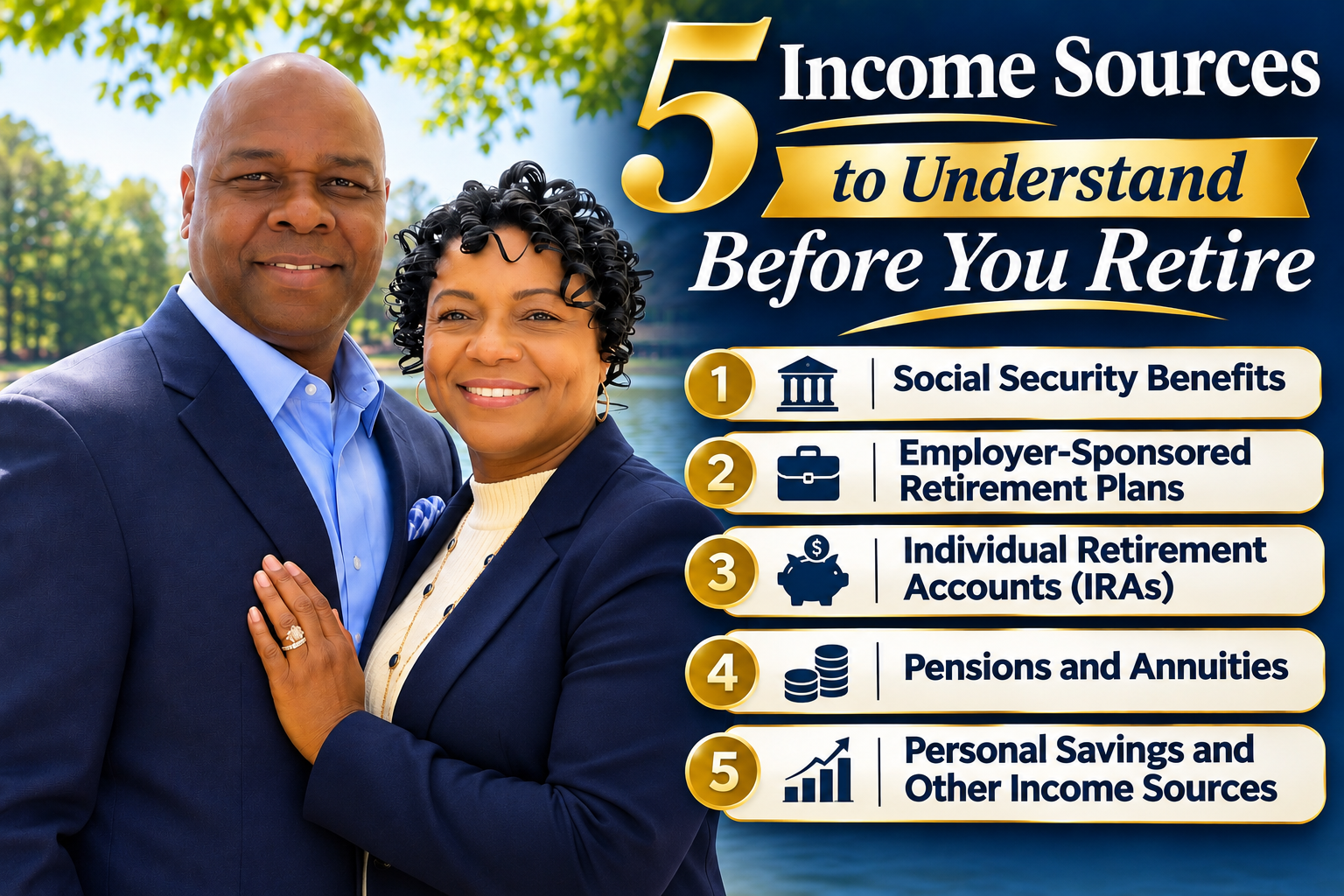
5 Retirement Income Sources to Know Before You Retire
5 Retirement Income Sources to Understand Before You Retire
You've worked hard to save for retirement. But have you thought about how those savings will become income when your regular paycheck stops?
For many people, preparing for retirement means contributing to a 401(k), IRA, or other retirement savings account. Watching those balances grow can provide a sense of accomplishment and financial confidence.
But there's another important part of retirement planning that often receives less attention: How will you turn your retirement savings into income that supports the life you want to live?
Retirement isn't simply the end of your working years. It's the beginning of a new financial chapter, one that may last 20, 30, or even more years.
Understanding where your retirement income may come from, how different income sources work together, and how to prepare for unexpected expenses can help you approach this next chapter with greater clarity.
Let's explore five potential retirement income sources and why each deserves consideration.
1. Social Security: An Important Piece of the Retirement Puzzle
Social Security provides a foundation of retirement income for millions of Americans.
However, the amount you receive depends on several factors, including your earnings history and the age at which you begin collecting benefits.
You can generally begin receiving retirement benefits as early as age 62. However, claiming before your full retirement age permanently reduces your monthly benefit compared with waiting until full retirement age.
For individuals born in 1960 or later, full retirement age is 67. Delaying benefits beyond full retirement age can increase monthly payments through delayed retirement credits, up to age 70.
Questions worth considering:
When should you begin receiving Social Security?
Will Social Security cover your essential living expenses?
How might your claiming decision affect your spouse?
Could a portion of your Social Security benefits be taxable?
Social Security is an important income source, but it may not be enough to support your desired retirement lifestyle on its own.
Understanding how it fits into your overall retirement strategy is an important first step.
2. Employer-Sponsored Retirement Plans: Putting Your Savings to Work
If you've contributed to a 401(k), 403(b), governmental 457(b), or Thrift Savings Plan (TSP), you've likely spent years building retirement assets through payroll contributions.
These accounts can be valuable resources during retirement.
However, accumulating money and withdrawing money are two very different financial activities.
During your working years, your focus may have been on contributing consistently and growing your account balance.
During retirement, the focus often shifts toward managing withdrawals, taxes, investment risk, and the possibility of outliving your savings.
Questions worth considering:
How much income might your retirement accounts provide?
When should you begin taking distributions?
How could market fluctuations affect your withdrawals?
What are the tax implications of distributions?
Would keeping your funds in your employer plan or exploring rollover options better suit your circumstances?
A rollover isn't automatically the best choice. Fees, investment options, services, withdrawal features, and tax considerations should all be evaluated before making a decision.
The objective is to understand how your accumulated retirement assets may help support your future income needs.
3. Traditional and Roth IRAs: Understanding the Tax Differences
Individual Retirement Accounts can also play an important role in retirement income planning.
Although Traditional and Roth IRAs are both designed to encourage retirement savings, they offer different tax features.
Traditional IRAs
Traditional IRAs may provide tax-deductible contributions, depending on your income, filing status, and participation in employer-sponsored retirement plans.
Investment earnings generally grow tax-deferred, and withdrawals are generally subject to ordinary income tax to the extent they represent previously untaxed amounts.
Roth IRAs
Roth IRAs are generally funded with after-tax dollars.
While contributions are not tax-deductible, qualified distributions can be received tax-free when applicable requirements are satisfied.
Having retirement savings in accounts with different tax treatments may provide flexibility when evaluating retirement withdrawals.
Questions worth considering:
How will withdrawals affect your taxable income?
Do you understand the differences between Traditional and Roth IRAs?
Could the timing of withdrawals influence your overall retirement income strategy?
Understanding the tax characteristics of your retirement accounts can help you make more informed decisions.
4. Pensions and Annuities: Exploring Retirement Income Options
For some retirees, a traditional pension provides a predictable source of income.
However, not everyone has access to an employer-sponsored pension.
Certain annuities may offer another way to establish a contractual retirement income stream.
An annuity is an insurance contract that can provide different features depending on the type of annuity selected.
Some annuities offer guaranteed income for a specified period or for life, subject to the terms of the contract and the claims-paying ability of the issuing insurance company.
Fixed indexed annuities, for example, may offer interest-crediting opportunities linked to the performance of a market index without directly investing in that index.
Depending on the contract, optional income riders may also be available.
It's important to understand that annuities are not suitable for everyone. They can involve surrender charges, liquidity restrictions, fees, caps, participation rates, and other limitations.
Questions worth considering:
Would having a predictable source of retirement income provide additional financial confidence?
How much flexibility do you need to access your money?
What costs, restrictions, and contractual provisions should you understand?
How might an annuity complement your other retirement income sources?
The goal is to understand the available options and determine which considerations are relevant to your circumstances.
5. Personal Savings and Other Income Sources: Creating Financial Flexibility
Retirement income doesn't always come exclusively from retirement accounts.
Other potential sources may include:
Personal savings and cash reserves
Rental property income
Business income
Part-time employment
Interest and dividends
Other available financial resources
These resources may provide flexibility for everyday expenses, unexpected costs, or personal goals.
For example, having accessible savings may help cover an unexpected home repair or healthcare expense without requiring an unplanned withdrawal from a retirement account.
However, different income sources carry different risks. Rental income may fluctuate, business income can be unpredictable, and investment income isn't guaranteed.
Understanding the reliability and accessibility of each source is an important part of retirement preparation.
What Happens When Your Paycheck Stops but Your Expenses Continue?
Here's a question worth asking:
If your regular paycheck ended tomorrow, where would the money come from to pay your monthly expenses?
Your mortgage or rent, groceries, utilities, transportation, insurance, and healthcare expenses may continue long after your working years end.
And retirement may introduce additional expenses that weren't part of your working-life budget.
Inflation can also affect your purchasing power over time.
A retirement income strategy should consider:
Essential monthly living expenses
Discretionary spending, such as travel and hobbies
Healthcare and potential long-term care needs
Taxes and inflation
Emergency reserves
Longevity and the possibility of living longer than expected
The objective isn't simply to have money available when you retire. It's to understand how your financial resources may support your needs and priorities throughout retirement.
Retirement Planning Should Reflect the Life You Want
For some people, retirement means traveling and exploring new places.
For others, it means spending more time with grandchildren, pursuing hobbies, volunteering, or enjoying a slower pace of life.
Whatever your retirement vision looks like, your financial strategy should begin with understanding what matters most to you.
A thoughtful retirement income strategy considers both the numbers and the life those numbers are intended to support.
Are You Saving for Retirement or Planning for Retirement Income?
Saving for retirement is an important accomplishment.
But knowing how your savings may translate into income is another essential part of preparing for the future.
You don't have to wait until your last day of work to begin exploring these questions.
The earlier you understand your retirement income options, the more time you may have to evaluate your choices and prepare for the years ahead.
Your Goals. Your Retirement. Your Way.
Retirement strategies should be designed around your life, your priorities, and your financial goals.
We help individuals, families, and business owners better understand retirement savings, income options, and financial protection strategies so they can make informed decisions about their future.
Are you preparing for retirement or wondering how your savings may provide income?
Explore our Retirement Strategies page and schedule your complimentary consultation today.
Educational purposes only. This material does not constitute individualized investment, tax, or legal advice. Financial strategies and products involve risks, costs, limitations, and eligibility requirements.
