Understanding 5 Types of Life Insurance: Which One May Fit Your Needs?
Understanding 5 Types of Life Insurance: Which One May Fit Your Needs?
Life insurance isn’t one-size-fits-all.
A young family protecting a mortgage may have very different needs from a business owner planning for the future or someone who wants lifelong coverage and the potential to build cash value.
That’s why understanding your options matters.
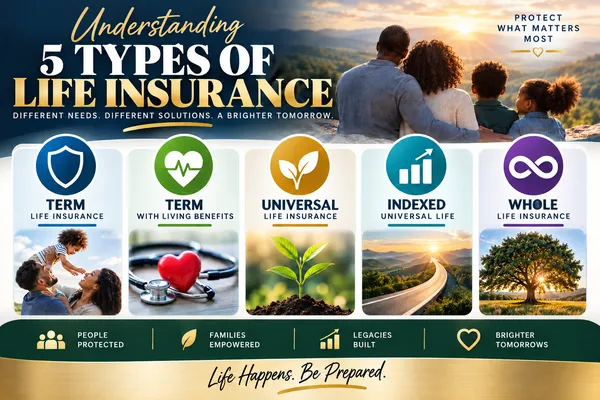
Here are five common types of life insurance and some of the features that make each one different.
1. Term Life Insurance
Simple protection for a specific period of time
Term life insurance provides coverage for a set period, such as 10, 20, or 30 years.
If the insured person passes away while the policy is in force, the policy generally pays a death benefit to the designated beneficiaries.
Because traditional term insurance is designed primarily for protection rather than cash-value accumulation, it can often provide a larger amount of death-benefit coverage for a lower initial premium than permanent life insurance.
Term life may be worth considering for:
Protecting a mortgage or other major debt
Replacing income during your working years
Protecting young children or other dependents
Providing coverage during a specific financial obligation
Think of term insurance as protection for a particular season of life.
2. Term Life Insurance with Living Benefits
Protection that may help while you're living
Some term life insurance policies include or offer riders commonly referred to as living benefits or accelerated death benefits.
Depending on the policy and rider provisions, these benefits may allow an eligible policyholder to access a portion of the policy's death benefit after certain qualifying events, such as a terminal, chronic, or critical illness.
Some products may also offer separate disability-related benefits or riders.
This can add another dimension to life insurance: protection isn't necessarily limited to what happens after death.
Depending on the policy, benefits may be available following qualifying events involving:
Critical illness — Certain covered serious medical conditions may qualify for benefits.
Chronic illness — Benefits may be available when an insured meets the policy's requirements related to an inability to perform specified activities of daily living or other qualifying criteria.
Terminal illness — A portion of the death benefit may be accessible following a qualifying terminal-illness diagnosis.
Disability — Certain policies or riders may provide benefits related to qualifying disability; terms vary by product.
Living-benefit provisions, eligibility requirements, exclusions, and benefit amounts can vary significantly, so it is important to understand exactly what a particular policy provides.
3. Universal Life Insurance
Permanent protection with flexibility
Universal life, or UL, is a form of permanent life insurance designed to remain in force for the insured's lifetime, provided the policy is adequately funded and policy requirements are met.
Unlike traditional term insurance, universal life can also accumulate cash value.
One of its distinguishing characteristics is flexibility. Within policy limits, a policyowner may have flexibility regarding premium payments and, in some cases, the death benefit.
Universal life may appeal to someone looking for:
Long-term life insurance protection
Greater premium flexibility
Cash-value accumulation potential
Coverage that can adapt as needs change
That flexibility also means the policy needs to be monitored. Changes in premiums, policy charges, credited interest, loans, withdrawals, or other factors can affect the policy's performance and how long it remains in force.
4. Indexed Universal Life Insurance
Permanent protection with index-linked interest potential
Indexed Universal Life, commonly called IUL, is another form of permanent life insurance.
Like traditional universal life, an IUL provides a death benefit and has the potential to accumulate cash value. The difference is primarily in how interest may be credited to the policy's cash value.
An IUL can credit interest based in part on the performance of a selected market index, subject to the policy's terms. The policyowner is not directly participating in or purchasing the index.
Policies typically include features such as caps, participation rates, spreads, floors, or other crediting provisions that determine how much interest is credited.
An IUL may provide:
Permanent life insurance protection
Cash-value accumulation potential
Index-linked interest-crediting options
Flexibility in premium funding, within policy guidelines
Potential access to accumulated cash value through withdrawals or policy loans
Life insurance also receives certain tax treatment under current federal tax law. Death benefits are generally received income-tax-free by beneficiaries, and properly structured policies may offer tax-deferred cash-value accumulation. Access through withdrawals and loans may also receive favorable tax treatment when applicable requirements are met.
However, tax treatment depends on individual circumstances and policy structure. Loans and withdrawals reduce policy values and the death benefit and may cause a policy to lapse, potentially creating tax consequences.
5. Whole Life Insurance
Lifetime protection with guarantees
Whole life is one of the most traditional forms of permanent life insurance.
It is generally designed to provide lifetime coverage with level premiums, a guaranteed death benefit, and guaranteed cash-value accumulation, assuming required premiums are paid and policy provisions are met.
Whole life may be considered by someone who values predictability and guarantees.
Common features include:
Lifetime insurance protection
Level scheduled premiums
Guaranteed cash-value accumulation
A guaranteed death benefit
Potential legacy planning uses
Some whole life policies may also be eligible for dividends. Dividends are not guaranteed and depend on the issuing insurer and policy.
So, Which Type Is Right for You?
The answer isn't simply, "Which policy is best?"
A better question is:
"Which type of coverage best fits what I need my life insurance to accomplish?"
Consider three questions:
1. How long do you need coverage?
Do you primarily need protection for a certain number of years, or would you prefer lifelong coverage?
2. What do you want the policy to accomplish?
Are you primarily protecting income and debt, or are cash value, flexibility, and legacy planning also important?
3. What can you comfortably maintain?
Life insurance is a long-term commitment. A policy should fit not only your goals today but also what you can reasonably maintain over time.
For some families, term insurance may provide exactly what they need. For others, permanent coverage may better align with long-term goals. And sometimes a combination of different types of coverage can be appropriate.
Protection Is Personal
Life insurance isn't only about preparing for death.
It's about helping protect the life you've worked to build—the people you love, the home you've created, the income your family depends on, and the legacy you hope to leave behind.
The goal isn't simply to have life insurance.
The goal is to understand what you have, why you have it, and whether it still fits your life.
Ready to Learn More?
If you're unsure which type of life insurance may fit your needs, start with education.
We can help you understand the available options so you can make an informed decision based on your goals, priorities, family, and financial situation. Schedule your complimentary education session today! https://calendly.com/sksimmons-sakfin/30min
Protect today. Prepare for tomorrow. Build your legacy.
This material is provided for educational purposes only and is not intended as tax, legal, or individualized financial advice. Life insurance products, riders, guarantees, costs, availability, and benefits vary by insurer and policy. Guarantees are based on the claims-paying ability of the issuing insurance company. Living benefits and accelerated death benefits are subject to eligibility requirements, limitations, exclusions, and policy provisions. Policy loans and withdrawals reduce cash value and death benefits and may have tax consequences. Consult the applicable policy contract and appropriate professionals regarding your individual circumstances.
